Part 1 – The Basics: How Satellite Phones Work
Satellite phones are increasingly in demand for emergency preparedness: How can I contact my family if a blackout causes power, mobile networks and the internet to fail? How do they work, which network is suitable, and what does this cover cost in the long term?
Our two-part blog post tries to answer these questions. This first part covers the basics. In Part 2 of this series, we’ll take a detailed look at the Thuraya XT-LITE, the backup SIM, and the benefits, costs, and unique features of this solution.
Why use a satellite phone for emergency preparedness?
In everyday life, we hardly notice how much communication depends on electricity and infrastructure. Mobile phone masts, exchanges, data centres and internet hubs only work as long as they are supplied with electricity. In the event of a widespread power cut, following severe storms or other disruptions, several of these systems can fail simultaneously. Emergency power reserves at mobile phone sites are often only designed to last for a limited time.
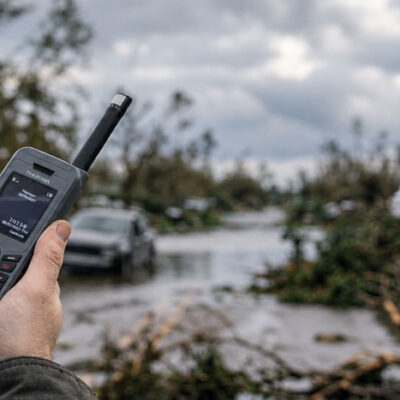
A satellite phone connects directly to a satellite in space and is therefore independent of local mobile and landline networks. This is why it is used as a last resort in contingency planning, for example:
- by families who wish to remain in contact with one another even during a network outage
- by companies and aid organisations that need to remain operational
- in remote areas, whilst travelling, on boats or on expeditions, where there is no network coverage anyway
It is important to have the right expectations: a satellite phone is not a replacement for a smartphone. It is a simple device for calls and text messages that can do very little – but it can do that even when everything else fails.
How does satellite communication work?
Satellite phones use satellites that orbit the Earth in two fundamentally different ways:
- Geostationary satellites are positioned at an altitude of around 36,000 kilometres and, as seen from Earth, remain at a fixed point in the sky. Just a few satellites are sufficient to cover large regions. To work, the phone must have a clear line of sight to precisely this point in the sky. Examples: Thuraya, Inmarsat.
- Satellites in low Earth orbit move rapidly across the sky at an altitude of a few hundred kilometres. This requires a large number of satellites to provide near-global coverage. The phone needs as unobstructed a 360-degree view as possible. Example: Iridium, with 66 active satellites.
In both cases, the same rule applies: without a clear line of sight to the satellite, there is no reception. Satellite phones generally do not work inside buildings, in cellars, in deep valleys or in dense woodland. Please forget all those Hollywood films in which satellite phones are used even in underground car parks and submarines. That’s nonsense. In an emergency, you’ll need to go outside or (if you’re very lucky) stand by an open window. If you want to use the satellite phone at your desk, you’ll need to install an antenna on the roof.
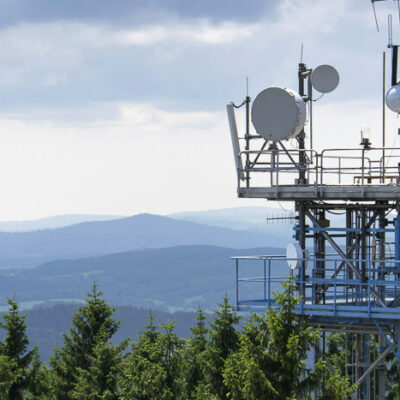
Calls between satellite phones and the standard telephone network are routed via the network operators’ ground stations (gateways). Calls from one satellite phone to another also usually go via such ground stations. A satellite phone is therefore independent of the local infrastructure, but not of the operator’s technology. Furthermore, as with any technology, there are maintenance windows and disruptions – there is no 100 per cent guarantee of availability, even with satellite communications.
An overview of the main networks
| Thuraya | Iridium | Inmarsat | |
| Satellites | geostationary | low Earth orbit | geostationary |
| Coverage | Europe, Africa, the Middle East | worldwide, including polar regions | almost worldwide, excluding the polar regions |
| Alignment | Unobstructed view of a fixed point in the sky | as clear a sky as possible | Unobstructed view of a fixed point in the sky |
| Typical handheld devices | Thuraya XT-LITE Thuraya XT PRO | Iridium 9555 Iridium Extreme 9575 | IsatPhone 2 and 2.1 |
| Special feature | Stable connection when in line of sight | Ongoing calls are transferred from one satellite to another; in exceptional cases, brief interruptions may occur whilst switching satellites | robust devices, wide coverage |
| See also | Thuraya satellite network | Iridium satellite network | Inmarsat satellite network |
Which network is best depends primarily on where you’ll be using it: if you want to be prepared for travel in Europe, Africa or the Middle East, Thuraya is often a good choice. Those travelling worldwide, or in the Americas and on the high seas, will need a network with different coverage. Before buying, it’s worth checking the provider’s coverage map and using tools such as DishPointer, which show where a geostationary satellite is positioned in the sky.


What a satellite phone cannot do
- No reception inside buildings; the antenna must have a clear view of the sky.
- Not a replacement for a smartphone: there are no apps and no fast internet; data speeds are very slow.
- Higher costs: Depending on the network and tariff, calls cost in the region of a few euros per minute – significantly more than standard mobile phone tariffs. You make outgoing calls with a satellite phone; calls from landlines and mobiles to a satellite phone are very expensive.
Availability: Who can call whom?
Satellite phones have their own phone numbers, for example with the prefix +88216 for Thuraya, +8816 for Iridium and +870 for Inmarsat. Calls from the standard telephone network are usually expensive and, in an emergency, may not be possible at all if your own landline or mobile network is down.
In terms of contingency planning, this means that communication from satellite phone to satellite phone is the most reliable option. Anyone wishing to reach others should therefore equip several people or locations with such devices.
Part 2 of this series provides a concrete example of how these principles can be put into practice: Using the Thuraya XT-LITE and the Prepaid Backup SIM as examples, it explains how to successfully plan for emergencies – especially for private individuals – at a reasonable cost, and what to keep in mind when doing so.